

Executive Summary / Abstract
Sports markets are usually built around endings. A sportsbook ticket pays or dies. A prediction-market contract resolves and disappears. A daily fantasy lineup resets. This whitepaper proposes a different market shape for cupcoin.fun: continuous sports markets, where fans can hold season-long game shares tied to teams, clubs, nations, drivers, or athletes. Events do not destroy these markets. Events update them. A goal, injury, upset, clean sheet, transfer, playoff win, or fan rush can move the chart while the position remains alive.
CUP stands for Continuous Unified Predictions. The name captures the platform thesis: continuous because sports positions can live through repeated games and seasons; unified because one ecosystem token can connect assets, packs, games, rewards, carry, and liquidity; predictions because every position still reflects fan belief about future performance.
The thesis uses an academic whitepaper structure but keeps the language accessible. It explains the market problem, reviews existing models, and recommends a two-layer design. The first layer is a continuous asset layer built around season-long sports stories. The second layer is an event game layer with rivalries, survivor pools, matchday arenas, best-ball-inspired contests, futures, packs, and arcade experiences. These games complement single-outcome markets rather than replace them.
CUP is positioned as the central ecosystem token for Continuous Unified Predictions. It gives every sport a shared unit for entry, routing, rewards, burns, packs, carry, and long-window liquidity. Instead of launching isolated tokens for every league, cupcoin.fun can add each sport as a spoke around the same CUP hub.
The core claim: sports events should create new market information, not force the market to restart from zero.
Keywords: Continuous Unified Predictions; continuous sports markets; season-long sports assets; prediction markets; fantasy sports; CUP; token utility; hub-and-spoke ecosystem design.
1. Introduction
Sports are not one-time facts. They are living stories. Fans follow form, injuries, transfers, lineups, rivalry history, standings, playoff odds, coaching decisions, weather, and momentum. Yet most sports-market products compress this rich story into a narrow question: who wins this event?
That question matters, but it is incomplete. A fan may believe a young player is breaking out. Another fan may believe an overlooked club is ready for a deep run. Another may want to hold a favorite team all season, watch its chart, and use that position in games. These are not just one-match opinions. They are season-long beliefs.
cupcoin.fun can turn those beliefs into a user-friendly market category. The experience should feel familiar to people who understand fantasy leagues, sports cards, odds, leaderboards, portfolios, and live charts. The technical details can sit underneath. The user-facing promise is simpler: buy the sports story, then watch the market move as the season unfolds.
1.1 Purpose and scope
This paper explains how continuous sports markets can work as a market design thesis for cupcoin.fun. The focus is product narrative, user behavior, token utility, liquidity design, and sport-agnostic expansion. It is written for a broad audience: fans, partners, community members, and builders who need to understand the model without reading code.
1.2 Research question
The central question is:
How can a sports platform keep user attention, liquidity, and token utility alive after individual games resolve?
The proposed answer is a two-layer system. A continuous asset layer gives users season-long positions. An event game layer gives users clear contests and short-term excitement. Both layers route activity through the same CUP ecosystem.
2. Background and Context
2.1 Sports already behave like an attention market
Sports create the conditions that markets need: frequent events, shared public information, emotional commitment, and strong communities. Pew Research Center reported that combined monthly global trading volume on Kalshi and Polymarket rose from less than $5 billion in September 2025 to about $24 billion in April 2026. In the same analysis, sports accounted for 80% of total Kalshi trading volume and 39% of Polymarket volume since July 2024 [2]. The American Gaming Association reported that U.S. sports betting generated $16.96 billion in revenue on $166.94 billion of handle in 2025 [3].
Those numbers do not imply that cupcoin.fun should copy sportsbooks or binary prediction markets. They show that fans already accept market-like sports products. The opportunity is to build a format that captures longer attention windows than a bet slip or a contract that vanishes after resolution.
2.2 The season-long audience is already trained
Season-long fantasy sports and best ball show that many fans want a longer arc than a single game. The Fantasy Sports & Gaming Association reported 62.5 million fantasy sports players in the U.S. and Canada in 2022, with 79% of fantasy participants playing fantasy football. The same industry page reports that 81% of fantasy sports players also bet on sports, and that 84% of fantasy players have a draft party with a median league-party spend of $653 [4].
DraftKings describes Best Ball as a full-season fantasy format with no roster management after the draft; users draft once, and top-scoring players automatically slide into lineups each week [5]. DraftKings also lists NFL Best Ball contests with large prize pools, including a $20 million featured contest with a $3 million top prize [6]. Underdog's 2023 Best Ball Mania IV release announced a $15 million prize pool, said the prior year's tournament had more than 451,000 entries, and described best ball as season-long fantasy that requires no management after drafting [7]. Sleeper's own site lists fantasy football, chopped leagues, pick'em, survivor, fantasy basketball, and fantasy soccer products, with several formats showing 1 million or more players [8].
The season-long habit is visible at mainstream scale. ESPN reported more than 14 million fans playing ESPN Fantasy Football in 2025 [9]. Fantasy Premier League describes a global game with more than 11 million managers [10]. Academic research also supports the engagement logic: Nesbit and King found evidence that fantasy participation increases NFL and MLB television viewing, while Karg and McDonald found that fantasy involvement complements traditional sport consumption [11, 12].
The lesson is direct: there is a large audience that enjoys drafting, holding, tracking, competing, and talking through a season. That audience is not fully served by single-event markets.
2.3 Current products each taught a useful habit
| Category | What users learned | What remains incomplete |
|---|---|---|
| Sportsbooks | Odds, props, parlays, and fast settlement. | The ticket ends after the event, so attention resets. |
| Prediction markets | Public prices can express belief about future outcomes. | Most markets resolve and disappear, splitting liquidity across questions. |
| Season-long fantasy | Fans enjoy drafting, holding, managing, and competing over months. | Rosters are usually not liquid assets that can be traded on a live market curve. |
| Best ball | Fans will commit to a season-long draft with little weekly management. | The roster is locked inside one contest instead of becoming part of a wider economy. |
| Trading cards and collectibles | Fans enjoy owning scarce sports objects. | Many items lack deep pricing, utility, or easy exits. |
| Trading apps | Users understand charts, watchlists, and portfolios. | Traditional apps do not make live sports stories playable. |
cupcoin.fun can combine these trained behaviors into one sports-native economy: portfolio ownership, event games, packs, social competition, and cross-season carry.
3. Problem Statement
The main problem is not that prediction markets, sportsbooks, fantasy sports, or collectibles lack demand. The problem is that their structures often separate sports attention from lasting liquidity.
3.1 The settlement problem
Single-outcome markets are strongest right before the result. Then the result arrives, and the product restarts. The closer the moment gets, the more people care. At the whistle, the contract, slip, or lineup is finished.
| Venue | What ends | Why it matters |
|---|---|---|
| Sportsbook | The bet slip. | The user wins or loses and needs a new reason to return. |
| Prediction market | The event contract. | Liquidity must be bootstrapped for the next question. |
| Daily fantasy | The lineup or slate. | The game resets and does not create a lasting position. |
| Best ball | The contest after the season. | The season-long arc is strong, but the roster does not become a liquid market object. |
| Collectibles | Nothing formally settles. | The object may remain illiquid without active price discovery. |
3.2 Four barriers created by one-off markets
First, attention resets. The platform must keep reacquiring the user for the next event. Second, liquidity fragments. Each new question, sport, league, or slate can create another small pool. Third, long-term fan beliefs are hard to express. A fan may be right about a team over 30 games, but one event contract only captures one outcome. Fourth, games and assets are separated. Users collect in one place, predict in another, and play fantasy somewhere else.
Prediction markets are excellent at resolving questions. They are less effective at preserving a season-long object that fans can hold, use, and build around after each question is answered.
4. Analysis of Existing Solution Models
A fair thesis should recognize that every existing model solves part of the problem.
| Model | Strength | Weakness | Best fit |
|---|---|---|---|
| Sportsbook | Simple, familiar, immediate. | House-priced and short-lived. | A user wants one fast wager. |
| Binary prediction market | Flexible and transparent. | Expires at resolution and can fragment liquidity. | A user wants a clear yes/no or multi-outcome question. |
| Daily fantasy | Social and skill-based. | Resets often and favors contest repetition. | A user wants a lineup contest. |
| Season-long fantasy | Durable social habit. | Usually lacks liquid, real-time market pricing. | A user wants league identity and months of engagement. |
| Best ball | Draft once, follow all season. | Locked roster utility is limited outside the contest. | A user wants low-maintenance season exposure. |
| Collectibles | Strong ownership feeling. | Liquidity can be thin and utility can be shallow. | A user wants fandom, status, and scarcity. |
| Continuous sports assets | Keeps positions alive across repeated events. | Needs serial events to shine. | A user wants a tradable sports thesis over time. |
4.1 Why continuous markets fit sports
Sports are serial. A team does not become interesting only on one day. Its story changes with every fixture, injury, upset, table movement, roster change, playoff result, and fan narrative. A continuous asset can absorb that stream of information.
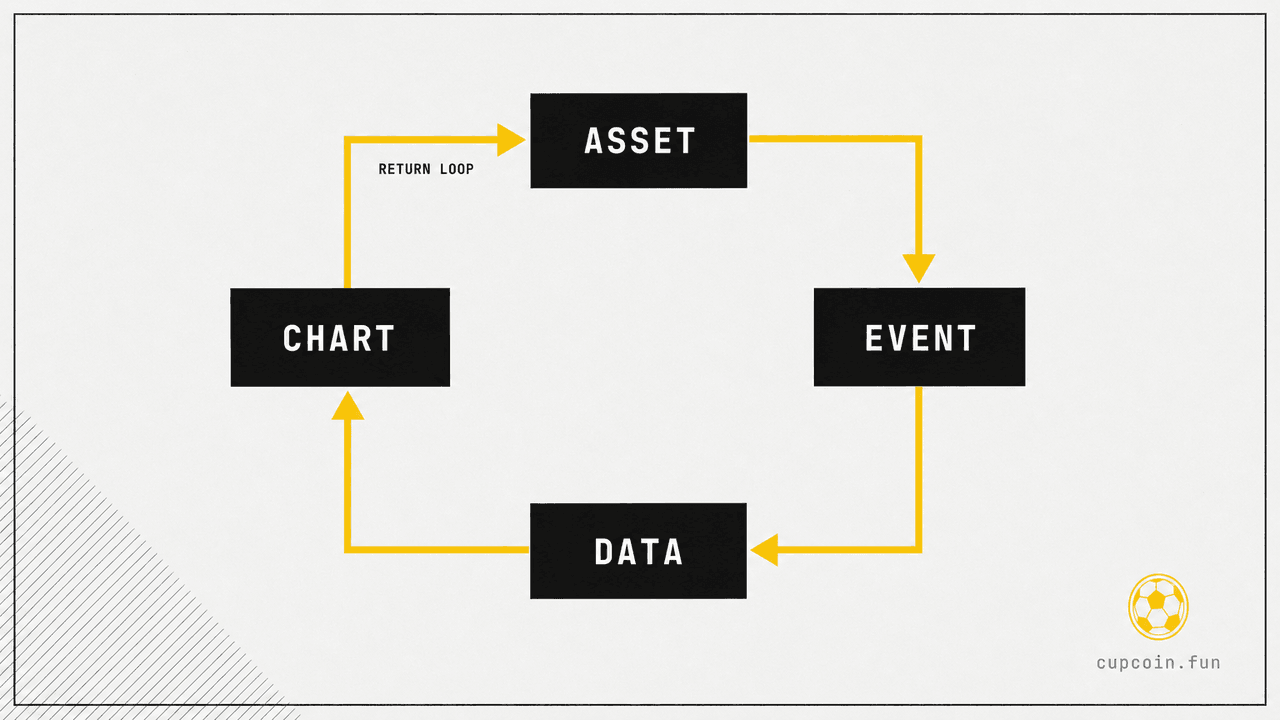
asset → event → data → chart → (return loop)This loop is the difference between an expiring answer and a live sports asset. A prediction market asks, will this happen? A continuous sports market asks, how does this new information change the asset?
4.2 Where continuous markets should not compete
A continuous sports market does not need to win every use case. A sportsbook may be simpler for a one-minute single-game bet. A binary prediction market may be better for arbitrary questions about politics, weather, or entertainment. A pure collectible may be better for a user who wants fandom without price movement.
cupcoin.fun should focus where sports are repeated: seasons, league tables, tournaments, playoff races, weekly player form, driver calendars, and multi-month fan narratives.
5. Proposed Solution: Continuous Sports Markets
The recommended design has two layers.
5.1 Layer 1: continuous sports assets
Layer 1 is the market layer. Teams, clubs, nations, drivers, or athletes can be represented as game shares in a season-long set. A user can buy, hold, sell, and track them. A market maker or curve can quote prices continuously so the user does not need to wait for another user on the other side of every trade.
Matchdays become market updates. A win, loss, goal, clean sheet, red card, injury, upset, transfer, or standings shift can be reflected in the asset's story. The asset remains alive through the season instead of ending after one game.
5.2 Layer 2: event games
Layer 2 contains the shorter games that give users clear action. Rivalries, survivor pools, matchday arenas, futures, packs, arcade modes, and best-ball-inspired contests can resolve on schedules. The difference is that they settle into the same CUP economy rather than becoming isolated experiences.
| Game model | User experience | Economic purpose |
|---|---|---|
| Rivalries | Back one side of a head-to-head fixture. | Creates short-term drama around assets that keep trading. |
| Survivor | Pick assets that must keep advancing or avoid elimination. | Turns many events into one longer journey. |
| Matchday arenas | Build a slate around a set of games. | Makes ordinary fixtures worth following. |
| Best-ball-style seasons | Draft or open a portfolio and let weekly scoring choose the best performers. | Converts season-long fantasy habits into asset ownership. |
| Futures | Express a longer view on champion, promotion, relegation, or award races. | Complements the asset layer with clear endpoints. |
| Packs | Open themed bundles tied to slates, leagues, derbies, or playoffs. | Makes onboarding easier and sends attention to multiple assets. |
| Arcade and live play | Play skill games, watch live moments, or join community events. | Gives users something to do between market updates. |
The system should not choose between continuous assets and single-outcome markets. It should use both. Continuous assets create the standing reason to return. Event games create the moment-to-moment reasons to act.
5.3 The prediction engine: Continuous Unified Predictions in practice
The abstract defines the name at the thesis level: continuous positions, one unifying token, and every position a standing prediction. cupcoin.fun also productizes the name directly with a prediction engine. For every upcoming fixture the platform publishes a full pre-match call: a predicted winner, a predicted scoreline, likely scorers, and the reasoning behind each. Calls are generated on a schedule rather than on demand, so every user reads the same call at the same time and nobody pays per question.
Continuous means a call is never a frozen snapshot. Each analysis regenerates as real information lands: fresh injury feeds, announced lineups, news retrieved live from cited web sources, and pre-match prices. The refresh window tightens as kickoff approaches so the final call absorbs the team sheets. Every call also passes through a refinement stage that must confirm or adjust the first draft against the latest news, and an upset methodology that requires the engine to identify the favorite and argue the strongest case against them before it is allowed to pick anyone.
Unified means one engine and one graded ledger across the platform. The same call powers the analyzer, the matchday hero, and the context around rivalries and arenas, and the same methodology extends to each new sport and season as spokes join the hub. Every prediction is stored before kickoff and graded after full time, misses included, so the record stays public and queryable.
The engine's first record comes from a leak-free backtest across the 92 finished World Cup 2026 games, with every prediction built only from information available before that kickoff: 70.7% winner accuracy overall, rising to 87.5% in the round of 32; 13% exact scorelines; stated confidence that tracked realized accuracy bucket by bucket; and a 16-3 flat-stake money line worth +11.9% ROI on the 19 games with a retrievable pre-match price. These figures will move as live calls grade in. They are printed because the discipline matters more than any single number: a prediction product that hides its misses is marketing, not market infrastructure.
A prediction that disappears after the whistle is a bet slip. A prediction that is stored, graded, and refined into the next call is market infrastructure.
Predictions are entertainment-grade analysis for game decisions inside the platform. They are not betting, financial, or investment advice, and the reader note in Appendix B applies to this layer in full.
6. CUP Tokenomics and Ecosystem Design
This paper treats CUP as the user-facing token of the cupcoin.fun ecosystem. Technical implementations may use chain-specific representations behind the scenes, but the market thesis is easier for fans to understand when the entire economy is explained around one token: CUP.
6.1 CUP as the sport-agnostic hub
CUP should not belong to one league, one sport, or one season. It should be the shared unit that connects every sport. Soccer, NFL, NHL, F1, basketball, baseball, tennis, golf, esports, or future formats can all operate as spokes around the same CUP hub.
In this model, CUP can serve five practical roles.
- 1.Entry unit. Users can use CUP to buy game shares, open packs, enter games, or participate in platform experiences.
- 2.Routing unit. Fees and game flows can route through a common rule set instead of separate sport economies.
- 3.Reward unit. Prizes, jackpots, staking distributions, and incentives can be denominated in the same ecosystem unit.
- 4.Sink unit. Burns, pack margins, fusion fees, and other sinks can reduce active circulating supply inside the ecosystem accounting.
- 5.Carry unit. Season-end carry can bridge old sport sets into future sport sets without creating a new token for every league.
6.2 Why not use SOL or ETH as the native ecosystem unit?
SOL and ETH are strong base assets with large markets. They are useful for infrastructure, settlement, and onramps. The question is whether they should be the main sports economy token. For cupcoin.fun, the stronger user thesis is to use CUP as the center and support base assets at the edges.
| Design question | SOL / ETH unit | CUP hub token |
|---|---|---|
| Brand clarity | The user is playing a sports game but holding a broad chain asset. | The token name and utility belong to the sports ecosystem. |
| Liquidity focus | Activity can leak into a general-purpose asset that is driven by many non-sports forces. | Sports activity concentrates around one sport-native unit. |
| Cross-sport carry | Credits would need to be priced against an external asset with no built-in sport memory. | Carry can be designed as a CUP-native bridge between sport sets. |
| Incentive design | Burns, rewards, and routing do not directly shape a platform-specific token economy. | Fees, burns, packs, and rewards can reinforce the same ecosystem unit. |
| User story | The token is an infrastructure asset first. | The token is the scoreboard and utility layer of the sports hub. |
| Tradeoff | Deeper external liquidity and familiarity. | Better internal alignment, brand ownership, and game-loop control. |
The recommended design is not anti-SOL or anti-ETH. Base assets can still help users enter and exit. The point is that the internal flywheel should be CUP-native so the value loop remains tied to sports participation.
6.3 The CUP flow model
The CUP flow model should be easy to explain:
- 1.Users trade sports assets, open packs, and play games.
- 2.Activity generates fees, game rakes, or pack margins.
- 3.Routing sends portions of flow to prizes, asset pools, jackpot budgets, staking distributions, burns, carry budgets, and operations.
- 4.Sports events update assets and create new reasons to return.
- 5.Season-end carry keeps users and capital moving into the next sport window.
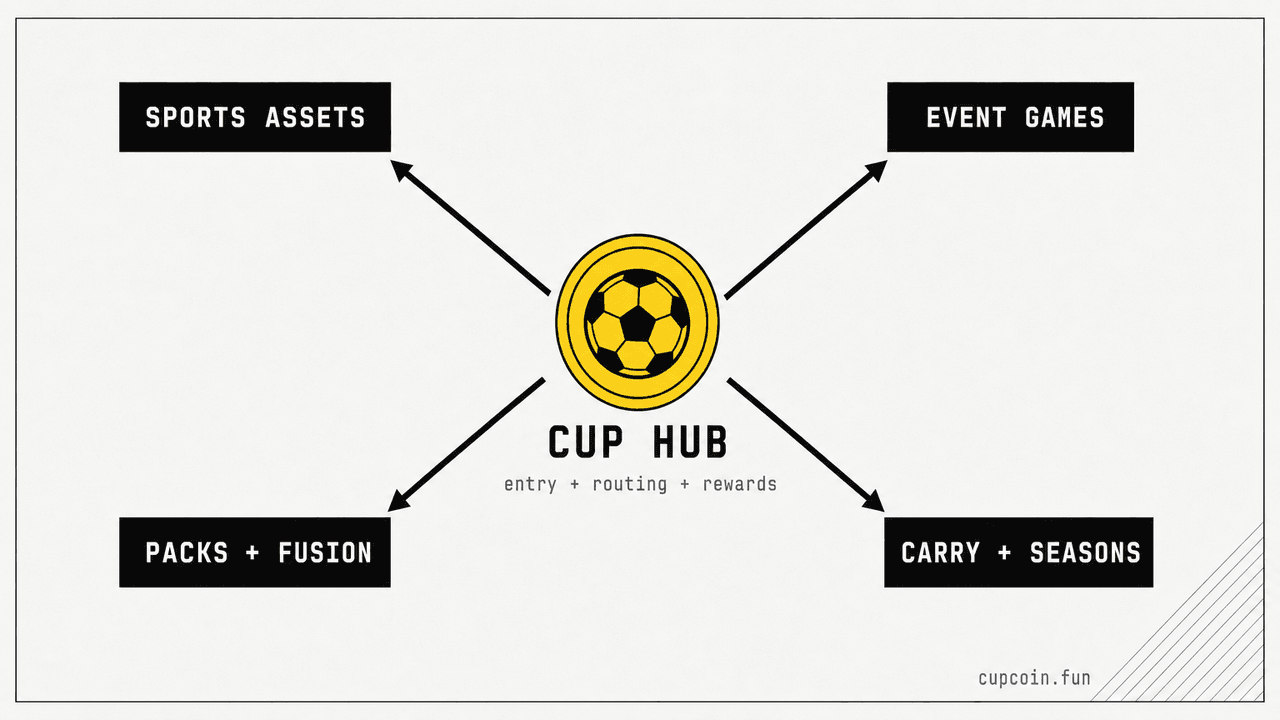
CUP hub (entry + routing + rewards) → sports assets · event games · packs + fusion · carry + seasons6.4 Current thesis mechanics
The uploaded platform thesis describes a fixed token supply, pre-funded emissions, fee routing, burns, pack economics, staking distributions funded by fees, and carry mechanics tied to fixed budgets rather than unlimited liabilities [1]. The exact numbers should be refreshed before public distribution. The important principle is stable: the economy should not depend on unlimited new issuance or promises of price support.
CUP works best when it is a utility and routing token for repeated sports activity. It should be supported by real platform use: trading, games, packs, prizes, burns, staking distributions, and carry.
7. Liquidity, Carry, and Longer-Window Utility
Liquidity is the ability to enter or exit a position without causing extreme price movement. Prediction-market liquidity is difficult because each event creates a new market, and users must decide whether to fund that new question. Chainlink's liquidity primer describes this as a cold-start problem: liquidity providers avoid markets with too few traders, while traders avoid markets with too little liquidity [13].
7.1 How CUP helps liquidity
CUP can help reduce fragmentation in four ways.
- 1.One denominator. Every sport uses the same ecosystem unit instead of separate sport tokens.
- 2.Persistent assets. A team or player asset can trade across many events instead of expiring after one result.
- 3.Shared routing. Fees from games, packs, and trades can feed the same sinks and reward routes.
- 4.Cross-sport carry. Users can move from a concluded sport set into an active or upcoming sport set through fixed-budget credits.
A single-event market captures attention for a few hours or days. A season-long asset can capture attention for months. A sport-agnostic token can extend that window across the calendar.
7.2 Cross-sport carry
Carry is the bridge between seasons. In a simple model, a user holding dead-season assets can burn or deposit those assets for credits into a future set. Cross-sport carry extends the idea across leagues. A soccer holder at the end of a May set could receive credits toward an NFL, NHL, F1, or next soccer set. A December F1 holder could roll into NFL playoffs or NHL assets. The token stays useful while the sport calendar changes.
The safest version of carry does not behave like a market-rate swap. Credits should be based on fixed rules such as listing tier or pre-announced weights, not on a last-minute spot price that whales can manipulate. Destination budgets should be fixed and pro-rata. If more users convert, each user's share of the budget self-dilutes rather than creating an unlimited obligation.
Cross-sport carry turns the end of one season into the opening ramp for another. This is how CUP can support a much longer usage window than a single tournament or league.
7.3 Calendar utility
The hub-and-spoke calendar reduces dead zones. Soccer, NFL, NHL, and F1 naturally peak at different times. A user does not need to disappear when one season ends. The platform can show the next active sport and provide a bridge into it.
| Sport | Typical arc | Role in a CUP hub |
|---|---|---|
| Soccer | Long league season plus tournaments. | Global club identity, rivalry weeks, promotion, relegation, and continental campaigns. |
| NFL | Weekly rhythm with playoffs. | Strong fantasy culture, survivor games, best-ball-style seasons, and high-intensity Sundays. |
| NHL | High game volume with long playoffs. | Frequent repricing and a deep elimination bracket. |
| F1 | Race weekends across the year. | Driver narratives, team changes, qualifying drama, and global event weekends. |
| Future spokes | Basketball, baseball, tennis, golf, esports, and more. | Additional calendars that feed the same CUP hub. |
8. Game Models that Complement Single-Outcome Markets
cupcoin.fun should keep simple outcome games where they make sense. A final, a derby, a playoff series, a top-scorer race, or a relegation battle can all support outcome-style contests. The strategic advantage is to connect those contests to assets that continue trading.
8.1 Recommended game families
| Game family | Concept | Why it fits |
|---|---|---|
| Rivalry Markets | Short head-to-head contests around major fixtures. | Keeps the clarity of single games while feeding the asset economy. |
| Survivor | Users pick assets that must avoid elimination or survive rounds. | Familiar to NFL fans and useful for tournaments. |
| Best-Ball Portfolios | Users draft or open a portfolio; the best performers count automatically each week. | Borrows a proven season-long fantasy habit and adds liquid assets. |
| Form Index | Rolling score based on recent performance. | Lets users care about hot streaks, not only final standings. |
| Underdog Ladder | Rewards lower-tier assets that beat expectations. | Gives smaller teams and athletes a reason to matter. |
| Derby Week Packs | Limited packs tied to rivalry weeks. | Turns real schedules into collectible moments. |
| Golden Boot / MVP Races | Season-long races around players or drivers. | Creates a repeated reason to follow individual performance. |
| Arcade and Live Modes | Mini-games, live clips, and skill-based moments around real events. | Gives users activity between market changes. |
8.2 Why best-ball ideas matter
Best ball shows that many users like season-long commitment without daily management. That insight maps well to cupcoin.fun. A user should be able to open a pack, draft a small portfolio, or join a season game and then follow the assets over time. The platform can automatically score the best performers, surface weekly highlights, and show which assets contributed to the user's rank.
This model reaches an audience that single-event markets often miss: users who enjoy a long season, group chat, draft nights, team identity, and weekly check-ins. It also gives users a reason to own multiple assets instead of only chasing the biggest match.
9. Hub-and-Spoke Expansion Model
The hub-and-spoke model is the operating structure for sport expansion. The hub is shared. Each sport is a spoke.
9.1 The hub
The hub includes CUP, asset curves, fee routing, packs, carry rules, staking distributions, jackpots, wallet rails, data handling, referrals, and engagement features. Building the hub once lets each new sport reuse the same foundation.
9.2 The spokes
A spoke is a league or sport package. It has its own teams or athletes, calendar, data feed, game formats, pack themes, and budget rules. It should not need a new token.
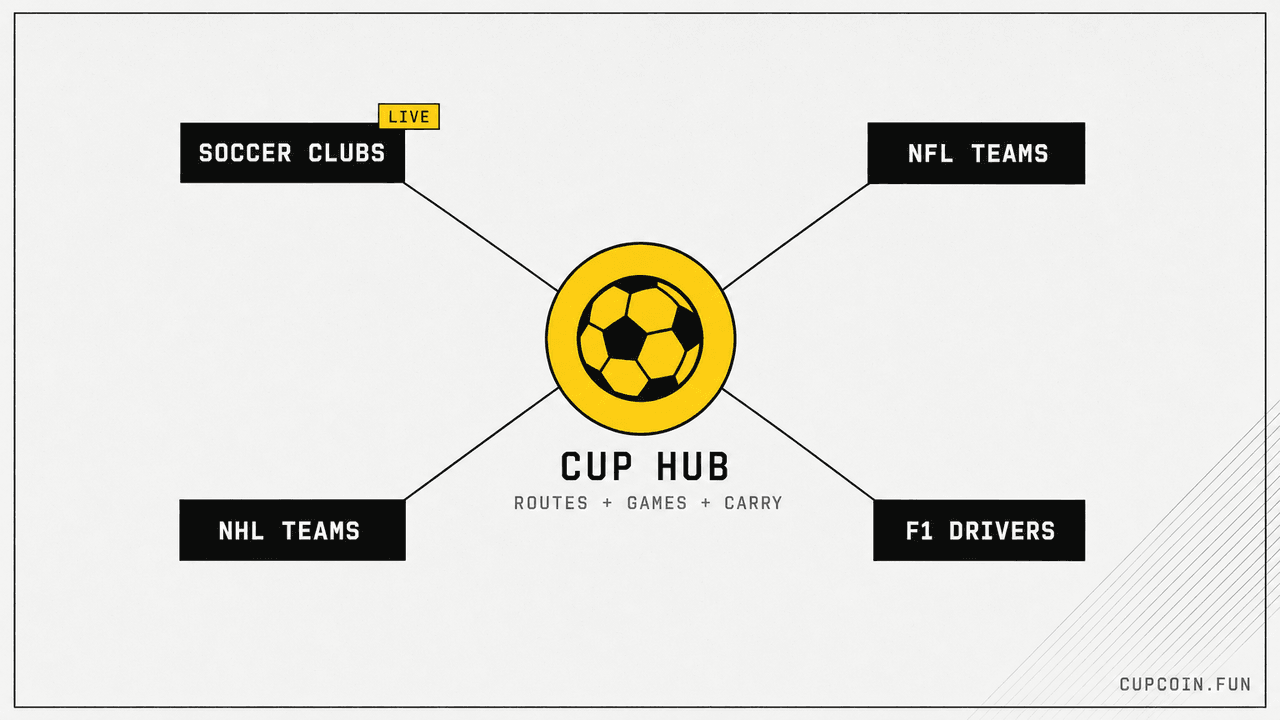
CUP hub (routes + games + carry) → soccer clubs · NFL teams · NHL teams · F1 drivers9.3 Expansion discipline
The greatest risk of a multi-sport platform is attention fragmentation. The solution is not to launch everything at once. The solution is staged launches tied to real calendar moments. Each spoke should start with a conservative budget, prove activity, and then scale. This protects the hub while giving users a year-round path.
10. Competitive Advantage
10.1 Against prediction markets
Prediction markets resolve questions. Continuous sports markets preserve assets. The difference changes retention and liquidity.
| Area | Single-outcome prediction market | Continuous sports market |
|---|---|---|
| Position life | Ends at resolution. | Can last through a season and carry into another set. |
| Liquidity | Split across many event questions. | Concentrated around assets that keep trading. |
| Information updates | Move one terminal probability. | Move an asset repeatedly. |
| User habit | Return for a new question. | Return because the portfolio is still alive. |
| Product surface | Mostly prediction. | Prediction plus fantasy, packs, live games, carry, and fandom. |
| Token utility | Often tied to collateral or settlement. | Tied to entry, routing, rewards, sinks, carry, and multi-sport activity. |
10.2 Against fantasy and best ball
Season-long fantasy and best ball prove users want long arcs. Their weakness is liquidity. A fantasy roster can be fun, but it usually cannot act like a liquid market position with a chart, price curve, and broad token utility. cupcoin.fun can borrow the season-long retention loop and add continuous price discovery.
10.3 Against collectibles
Collectibles create emotional ownership. Their weakness is often market depth and utility. A continuous asset can keep the ownership feeling while adding live repricing, games, packs, carry, and routing through CUP.
Sportsbooks sell tickets. Prediction markets sell expiring answers. Fantasy leagues sell season-long attention. cupcoin.fun can combine the season-long attention with liquid sports assets.
11. Risks and Guardrails
The model should be marketed with confidence and operated with discipline.
| Risk | What could go wrong | Guardrail |
|---|---|---|
| Attention fragmentation | Too many sports launch at once. | Stage launches and scale from actual activity. |
| Liquidity fragmentation | Games and assets split users into too many pools. | Keep one CUP hub and connect games back to assets. |
| Reward overcommitment | Prize floors exceed safe budgets. | Pre-fund prize budgets and cap liabilities. |
| Oracle/data issues | Delayed or wrong sports data affects settlements. | Isolate by league and event, use dispute windows, and avoid freezing unrelated markets. |
| Live-feed arbitrage | Fast users react before official data updates. | Drip event-based updates over time and improve live ingest speed. |
| IP and likeness risk | Team, league, athlete, or logo use creates rights issues. | Use text-first naming unless rights are secured and review each spoke. |
| Confusing token language | Users mistake game mechanics for profit promises. | Explain utility, avoid price targets, and keep compliance language clear. |
| Base-asset dependence | External chain assets dominate the user story. | Use base assets for access, but keep CUP as the internal sports economy unit. |
11.1 Compliance posture
cupcoin.fun should use clear language. Game shares are not ownership in real-world teams, clubs, leagues, athletes, drivers, or associations. Rewards and prizes should be presented as game mechanics funded by fees or pre-funded budgets. The paper should avoid yield promises, buyback promises, price targets, or language that makes CUP sound like a passive investment contract.
12. Conclusion
Sports fans already understand the parts of this thesis. They understand picks, odds, charts, lineups, draft nights, standings, cards, and playoff races. cupcoin.fun can connect those habits into a single game economy.
The category is continuous sports markets. In this model, teams, clubs, nations, drivers, and athletes become season-long game shares. Events update the chart instead of killing the position. Event games still exist, but they sit on top of a living asset layer. Packs onboard users. Best-ball-style contests create season-long portfolios. Carry bridges dead seasons into new ones. CUP connects the whole structure as the sport-agnostic token for entry, routing, rewards, sinks, and long-window utility.
The final thesis is direct: do not make every sports market die at the whistle. Let the whistle create the next market update.
References and Data Sources
- 1.cupcoin.fun. (2026). Continuous Sports Markets — the platform thesis. Internal uploaded source document, dated July 6, 2026.
- 2.Pew Research Center. (2026). Trading volume on prediction markets has soared in recent months. https://www.pewresearch.org/short-reads/2026/05/27/trading-volume-on-prediction-markets-has-soared-in-recent-months/
- 3.American Gaming Association. (2026). Commercial gaming revenue hits $78.7 billion in 2025, driving record $18.1 billion in gaming taxes nationwide. https://www.americangaming.org/commercial-gaming-revenue-hits-78-7-billion-in-2025-driving-record-18-1-billion-in-gaming-taxes-nationwide/
- 4.Fantasy Sports & Gaming Association. (2026). Fantasy Sports & Gaming Industry. https://thefsga.org/fantasy-sports-gaming-industry/
- 5.DraftKings. (2026). Best Ball Fantasy Sports. https://www.draftkings.com/best-ball
- 6.DraftKings. (2026). NFL Best Ball DFS 2026. https://www.draftkings.com/nfl-best-ball
- 7.Underdog. (2023). Underdog launches largest fantasy football tournament of all-time with $15 million prize pool. https://www.underdogsports.com/news/underdog-launches-largest-fantasy-football-tournament-of-all-time-with-15-million-prize-pool
- 8.Sleeper. (2026). Fantasy Football, Basketball, Esports, and Daily Fantasy Sports. https://sleeper.com/
- 9.ESPN Press Room. (2025). All-time record four years in a row: 14 million fans playing ESPN Fantasy Football in 2025. https://espnpressroom.com/us/press-releases/2025/09/all-time-record-four-years-in-a-row-14-million-fans-playing-espn-fantasy-football-in-2025/
- 10.Premier League. (2026). Fantasy Premier League. https://fantasy.premierleague.com/
- 11.Nesbit, T. M., & King, K. A. (2010). The impact of fantasy sports on television viewership. Journal of Media Economics, 23(1), 24-41. https://pure.psu.edu/en/publications/the-impact-of-fantasy-sports-on-television-viewership/
- 12.Karg, A. J., & McDonald, H. (2011). Fantasy sport participation as a complement to traditional sport consumption. Sport Management Review, 14(4), 327-346. https://www.sciencedirect.com/science/article/pii/S1441352310000756
- 13.Chainlink. (2026). The Dynamics of Prediction Market Liquidity. https://chain.link/article/prediction-market-liquidity
- 14.Gebele, J., & Matthes, F. (2026). Semantic Non-Fungibility and Violations of the Law of One Price in Prediction Markets. arXiv:2601.01706. https://arxiv.org/html/2601.01706v1
- 15.Maresca, C. (2026). Can Interest-Bearing Positions Solve the Long-Horizon Problem in Prediction Markets? arXiv:2602.21091. https://arxiv.org/abs/2602.21091
Appendix A: Glossary
| Term | Meaning |
|---|---|
| Continuous market | A market that stays alive after one event ends. |
| Continuous Unified Predictions (CUP) | What CUP stands for: continuously regenerated, publicly graded AI match calls, unified across sports, seasons, markets, and games — and the name of the ecosystem token. |
| Single-outcome market | A market that resolves around one question, such as yes/no or winner/loser. |
| Game shares | User-facing sport assets inside the platform; not ownership of real-world teams or athletes. |
| Asset layer | The season-long layer where teams, clubs, nations, drivers, or athletes can trade as game assets. |
| Event game layer | The layer of contests, rivalries, packs, arenas, futures, and other games built around events. |
| Curve | An automated pricing rule that lets users buy or sell without waiting for another user to take the other side. |
| Oracle | A data system that reports sports results or events to the platform. |
| Hub | The shared CUP ecosystem center used across sports and games. |
| Spoke | A league or sport that connects to the hub. |
| Carry | A season-end bridge from old assets into a future set. |
| Burn | A token sink that removes tokens from active circulation inside the ecosystem accounting. |
| Pack | A randomized bundle of game shares, similar to a digital card pack. |
| Best ball | A fantasy format where users draft a roster and the platform automatically counts the best performers over the season. |
Appendix B: Reader Note
cupcoin.fun is an independent game and is not licensed by, affiliated with, endorsed by, or sponsored by FIFA, UEFA, the NFL, NHL, F1, any national football association, any league, any club, any team, any player, any driver, or any rights holder unless a specific relationship is separately announced. This paper describes product concepts, market structure, and ecosystem design. It is informational and should not be read as legal, financial, tax, or investment advice. Game rewards, jackpots, staking distributions, injections, prize pools, and carry windows should be understood as game mechanics funded by collected fees or pre-funded budgets, not as promises of profit, yield, buybacks, or price support.